
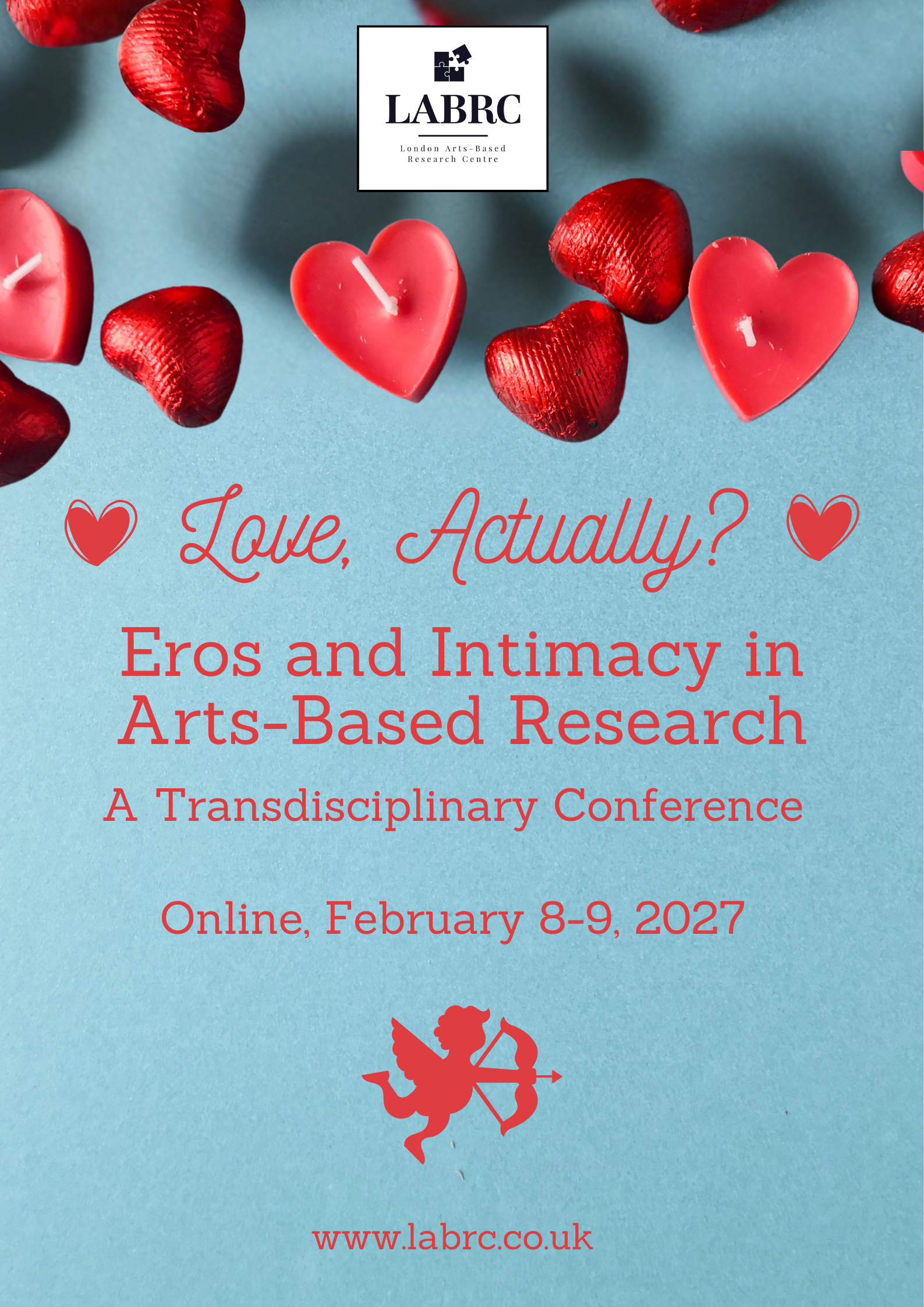

Love, Actually?
Eros and Intimacy in Arts-Based Research
A Transdisciplinary Conference
Organised by the London Arts-Based Research Centre (LABRC)
Dates: February 8-9, 2027
Where: Online, via Zoom
Proposal Deadline: December 15, 2026
Conference Fee: £100
Prices exclude booking fees
Call for Presentations
What does it mean to love? And what might love allow us to know?
Love has long occupied a paradoxical place in human experience. It draws us towards others while unsettling our sense of self; it inspires acts of creativity, devotion, and care, yet also exposes us to longing, vulnerability, loss, and transformation. It can unite and divide, liberate and possess, illuminate and obscure. Across cultures and disciplines, love has been imagined as an emotion, a virtue, a biological impulse, a spiritual practice, a political force, and a way of understanding our relationship with the world.
But what if love is not simply something we experience, represent, or study? What if love itself can become a way of knowing?
This transdisciplinary conference invites scholars, artists, writers, researchers, therapists, practitioners, and creatives from all disciplines to explore love in its many forms, expressions, and contradictions. Moving beyond the exclusively romantic, we seek to examine love as an aesthetic, psychological, philosophical, cultural, embodied, and relational phenomenon.
From the myth of Eros and Psyche to contemporary understandings of intimacy and attachment, from poetic longing to the ethics of care, from the chemistry of attraction to the transformative possibilities of artistic encounter, love continues to shape how we imagine ourselves and our relationships with others.
In Jungian psychology and arts-based research, Eros has often been associated with relatedness, connection, and the movement towards relationship. Yet love also complicates the boundaries between self and other, desire and projection, intimacy and possession, knowledge and mystery. What happens when we allow ourselves to be affected by it? Can love deepen understanding without diminishing the otherness of what we seek to know? What emerges, and what do we learn, as we create?
Art and literature have long provided spaces in which such questions can be explored without requiring their contradictions to be resolved. A poem may give form to longing without satisfying it. A painting may invite intimacy while preserving distance. Music may communicate experiences for which ordinary language remains inadequate. Through creative practice, love can become not only a subject of representation but a process of discovery.
We invite 15-minute presentations that approach love as a question rather than a settled definition, and that explore its capacity to generate knowledge, creative expression, ethical responsibility, and transformation.
Contributions may engage with, but are not limited to, the following themes:
Love, Eros, and the Psyche:
- Eros and Psyche in mythology, literature, and psychology
- Jungian and archetypal approaches to love and desire
- Love, the unconscious, projection, shadow, and individuation
- Anima, animus, and contemporary critiques of gendered psychological models
- Desire, fantasy, obsession, and the erotic imagination
- Love, longing, absence, and the experience of otherness
Love as a way of knowing:
- Eros as epistemology and research methodology
- Love, intuition, imagination, and relational knowledge
- Arts-based research, poetic inquiry, and embodied knowing
- Attraction, beauty, and aesthetic experience
- Love, attention, curiosity, and the ethics of encounter
Love in literature, art, and creative practice:
- Representations of love across literary genres and periods
- Love poetry, erotic writing, and the language of desire
- Love in painting, photography, sculpture, and performance
- The expression of intimacy in music, dance, cinema
- The erotic imagination across artistic movements (Surrealism, Romanticism, Modernism, etc.)
- Creative practice as an expression or investigation of love
- The relationship between artist, artwork, and audience
The body, desire, and intimacy:
- Embodied love, sensuality, and sexuality
- The neuroscience and psychology of attraction and attachment
- Touch, pleasure, vulnerability, and intimacy
- Queer love and non-normative relationships
- Love, ageing, illness, and bodily change
- Digital intimacy, virtual relationships, and artificial intelligence
- Desire, consent, and relational ethics
Love, loss, and transformation:
- Unrequited love, heartbreak, and separation
- Grief, mourning, memory, and continuing bonds
- Love and the experience of absence
- Love, trauma, healing, and therapeutic relationships
- Forgiveness, reconciliation, and the limits of love
- Love as a catalyst for psychological and creative transformation
Love, society, and the politics of care:
- Feminist, queer, and decolonial theories of love
- Love, power, possession, and social inequality
- Care ethics, compassion, and responsibility
- Motherhood, parenthood, kinship, and chosen families
- Friendship, community, belonging, and solidarity
- Love as resistance, activism, and political imagination
- The commodification of love and intimacy
Love beyond the human:
- Ecological love and relationships with the natural world
- Biophilia, environmental care, and more-than-human intimacy
- Love for places, landscapes, objects, and cultural heritage
- Spiritual, mystical, and divine love
- Devotion, transcendence, and the sacred
- Love, technology, and emerging forms of relationality
We welcome contributions from across the humanities, arts, social sciences, psychology, education, health, and related fields.
We particularly encourage contributions that experiment with how love might be explored, communicated, or investigated through artistic and scholarly practices.
Submission Guidelines
Participants interested in attending without presenting are also welcome.
Please submit a 250-word abstract along with a short bio on this form by December 15, 2026.
For inquiries, feel free to contact us on conferences@labrc.co.uk
*By purchasing a ticket for this or any of the London Arts-Based Research Centre events, you acknowledge and agree to the Terms and conditions and Privacy policy